Bank statements
Israeli bank statement translation for a European bank
Your current-account statement rebuilt in English — every transaction reproduced and the running-balance chain verified from the opening to the closing figure.
Price
from ₪79 + ₪12/page
- incl. VAT
- turnaround quoted per order
- signed certificate of accuracy included
What the bank is checking
Lenders trace balances and cash flow across months, and a broken balance chain reads as an altered document. We reproduce every row and verify the running balance line by line, so the account activity the bank relies on is provably intact.
- Every transaction row reproduced in order
- Running-balance chain verified opening to closing
- Dates, references and amounts preserved exactly
How an Israeli account statement is built
An Israeli current-account statement is a transaction ledger: one line per movement, in date order, with a running balance carried down the page and forward to the next. The account type itself — עובר ושב, literally “coming and going” — is what English calls a current or checking account.
Two things regularly surprise a reader abroad. A line can carry two dates: the transaction date and the value date, which is the date the bank counts the money from for interest. And each line carries a reference number tying it back to the underlying instruction — a standing order, a cheque, a card settlement — which is what a compliance officer follows when they want to trace one payment.
Because the balance is cumulative, a page lifted out of the middle of a statement does not stand on its own. We translate the statement as issued, in sequence, and check the balance forward from the opening figure to the closing one.
Column headings and common terms, and how they read in English
A short selection from the working glossary. Each bank words its columns slightly differently.
| On the Hebrew document | In the English translation |
|---|---|
| עובר ושב | Checking accountoften abbreviated עו״ש on the document itself |
| תאריך ערך | Value Date |
| אסמכתא | Reference |
| פעולה | Transaction |
| חובה / זכות | Debit / Credit |
| יתרה בש״ח | Balance in NIS |
| העברה מדף קודם | Brought Forward from Previous Page |
The original and the translation, side by side
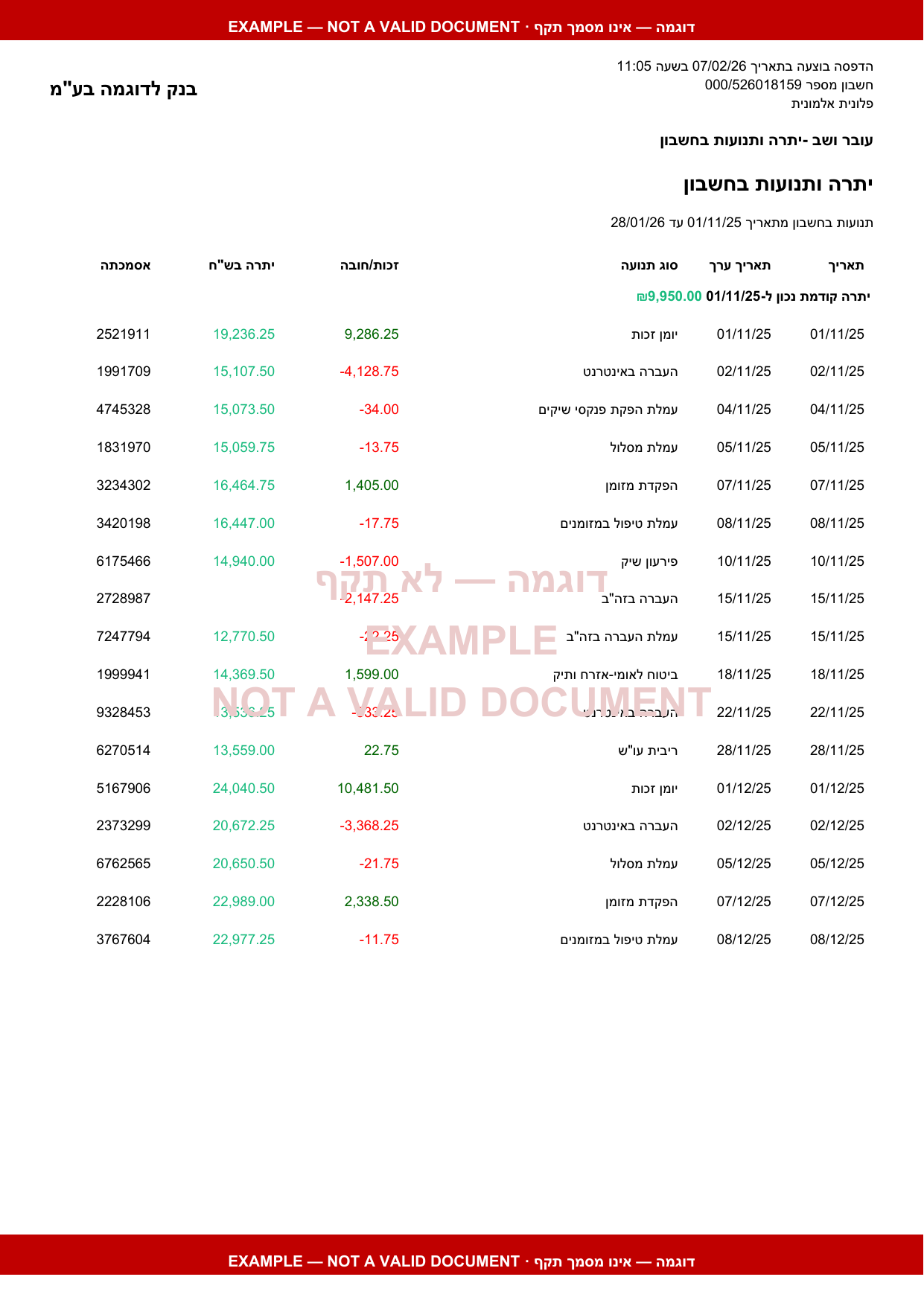
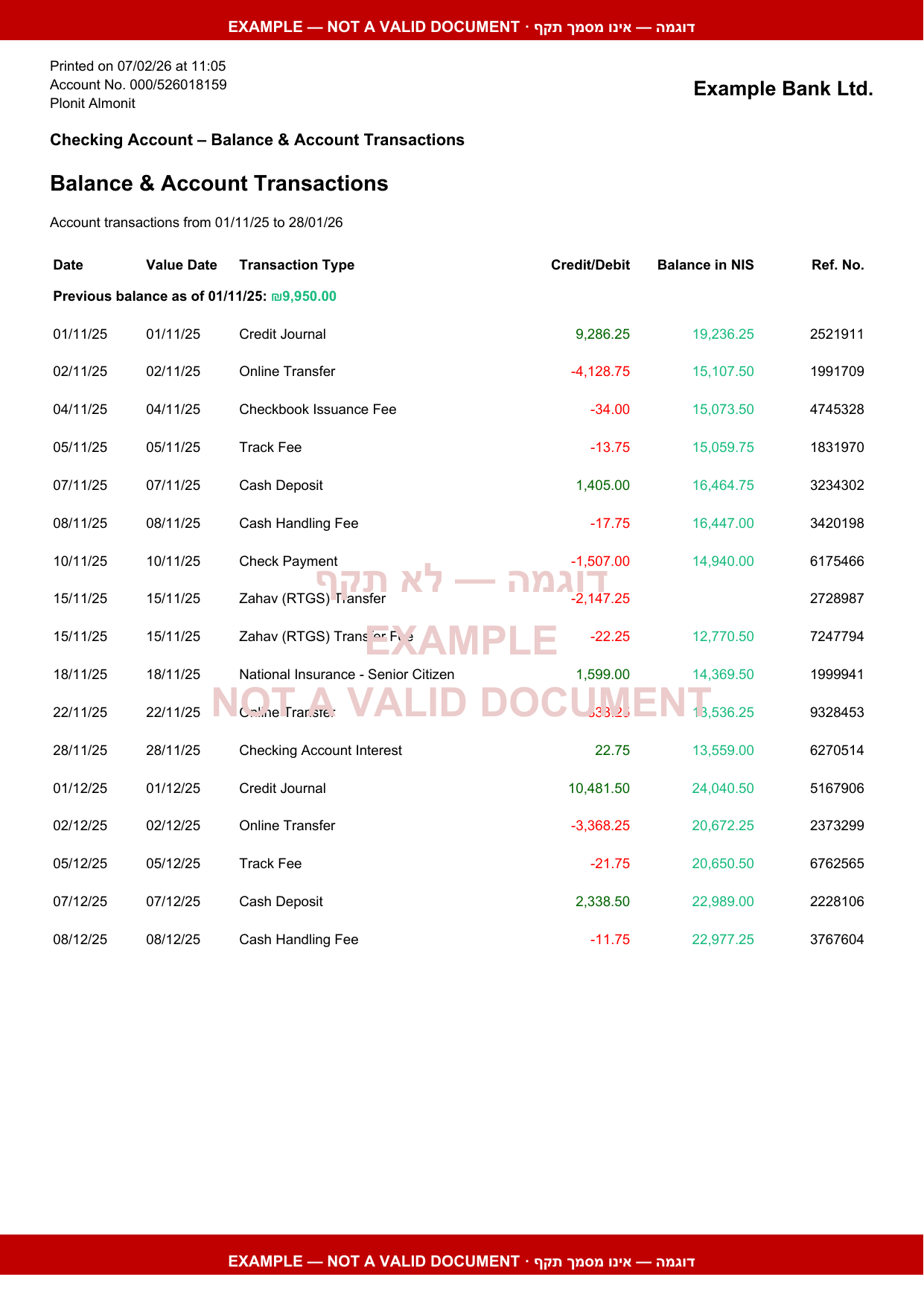
Every quote is confirmed with you before any work begins, and the price you accept is the price you pay. See full pricing
Who asks for it, and what they accept
Statements are the workhorse document of a mortgage file abroad, of source-of-funds review, and of financial disclosure in a court case. Recipients almost always want the statement in full: a translated opening balance, closing balance and total is a summary, not a translation, and it is the form most likely to be sent back.
A certified translation — the complete statement in English with a signed statement of accuracy — is what is generally required. Each institution sets its own rules, and confirming what yours accepts rests with you or your adviser; where a notary is required, we can refer you to one.
Common questions
How many months of statements does a bank need?
Typically three to six months of the main current account. The price follows the page count, and the full quote is always confirmed with you before we start.
My statement runs to many pages — how is it priced?
From ₪79 including VAT plus ₪12 a page. Send the document and we'll confirm the full price before any work begins.
Does the bank need the Hebrew original too?
The English translation is what the reviewer reads, and many banks keep the original on file with it. We deliver a clean PDF that mirrors the original so the two correspond line for line.
Can the balances be checked?
Yes — we verify the running-balance chain ourselves as part of the work, and a signed certificate of accuracy is included on request.
Will an Israeli statement satisfy a UK student visa application?
Israeli nationals are not on UKVI's list of countries exempt from proving funds, so the financial evidence has to be submitted in full. For the Student route gov.uk states that "You must have this money for at least 28 days in a row" and that the 28-day period must end within 31 days of the date you apply — which is more than an Israeli bank's balance confirmation shows, since that states a balance on a date rather than a period. A transaction statement covering the 28 days is the document that meets it, and in Israel that is normally a Hebrew document. UKVI's certification standard is the ordinary one: a statement that the translation is accurate, the date, and the translator's full name and contact details — no sworn register, no notary and no apostille. (gov.uk, read July 2026.)
Ready to translate your statements?
Print-ready PDF · handled in confidence · a few days for most jobs