Exact visual fidelity
The English mirrors the original — same tables, borders, order and layout — so the document reads cleanly and nothing about it invites a second look.
Hebrew → English · Financial & legal documents
Payslips, Form 106s and bank statements, rebuilt in English line for line and figure for figure — so your client's mortgage or property purchase moves forward instead of stalling over the paperwork.
Every figure checked & matched to the original
What actually holds up a file
Portuguese and other European banks generally work from the translation itself — they only ask for the Hebrew original if something looks inconsistent. That's exactly why accuracy and a faithful, original-matching layout matter: a translation that reads cleanly and mirrors the source doesn't invite a second look.
A small error or a mismatched figure is what triggers a request for the original, an apostille, or re-submission — and, with a stricter bank, a demand that documents be notarized in Israel. That adds weeks and real cost. Property deals have stalled over exactly this.
Anything that looks off invites questions — and the file waits while they're resolved.
A flagged file can lead to a demand for full Israeli notarization — time and money the deal didn't budget.
Financing dates move, and a straightforward purchase turns into a scramble.
The standard
The English mirrors the original — same tables, borders, order and layout — so the document reads cleanly and nothing about it invites a second look.
Every subtotal, total and net figure is re-added and checked against your document — the math has to balance before the document can ship. ID and account numbers are checked digit by digit, because a single wrong one can sink a mortgage.
What we translate
Israeli financial and legal paperwork, prepared in English exactly as the receiving institution expects to see it.
Monthly salary slips rebuilt with every line — gross, deductions, contributions and net — in place and checked.
The annual employer tax summary, reproduced field for field with every total checked.
Full transaction histories with running balances carried through and verified line by line.
Provident, pension and study-fund statements with holdings and contributions faithfully carried across.
Income-tax assessment notices reproduced with their official structure and figures intact.
Invoices, business-ownership and employment confirmations, translated for self-employed and company files.
Annual and quarterly statements — balance sheet, P&L, cash flows and notes, checked line by line in English.
Medical certificates and insurance or reimbursement paperwork, translated for claims and official submissions.
Bank of Israel credit-data summaries reproduced in full, charts and all.
Employer letters, account-management and ownership confirmations, rendered on their official layout.
See the difference
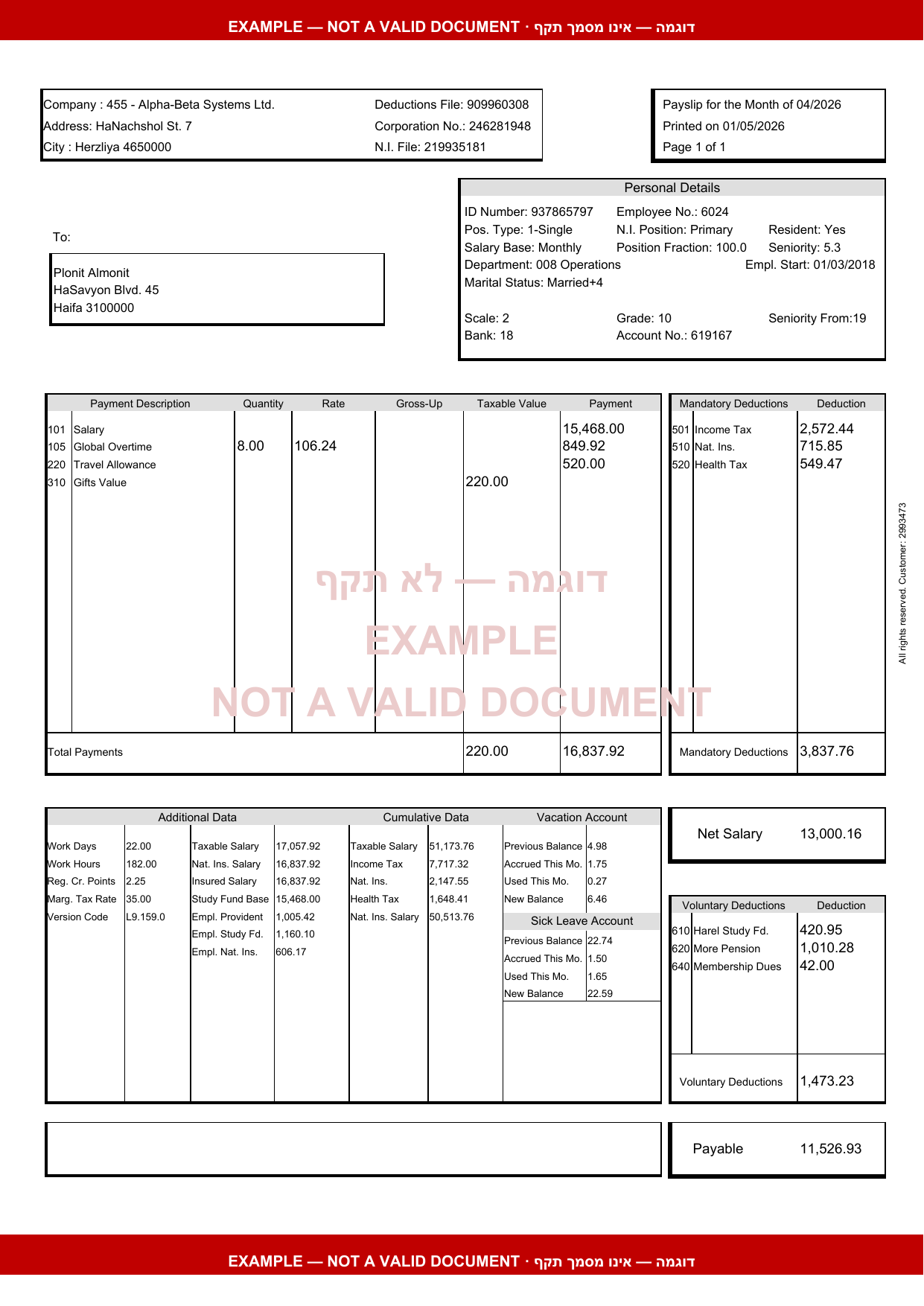
This is an Israeli payslip rendered from our production template with sample data — the same template your client's documents run through. The figures are fictional; the fidelity is real.
Why it holds up
Every figure is read from your document, every time.
On fixed-layout forms and statements the layout is compared against the original by measurement, not by eye; on flowing documents the comparison is made page by page. The math is re-done and has to match — never trusted at a glance.
You receive a faithful PDF built from real, checked text — not a photo of a document — ready to submit as-is. A signed certificate of accuracy is included on request.
Your documents are handled in strict confidence — used only to prepare your translations, and never published, shared, or reused for anyone else.
Formatted for what European and Portuguese banks and institutions expect to receive — and to accept.
No figure is ever invented, rounded or quietly 'fixed'. Amounts stay in the currency your document prints them in — we never convert a currency or work out a figure the source does not state. If a source and its arithmetic disagree, you're told — not surprised later.
Questions
We produce the translation itself, and a signed certificate of translation accuracy is included on request. Formal certification or an apostille is a separate step, and for most bank submissions the translation is all that's needed. If your bank or notary does require a certified or apostilled version, tell us what they've asked for and we'll set out the steps.
Usually not. Portuguese banks generally accept income documents in English, so in most cases an English translation is what you'll submit — though some banks ask for a Portuguese translation or an apostille. Where Portuguese, certification, or an apostille is required, we can set out the steps.
Most jobs turn around in a few days. Urgent work with a stated deadline can often be accommodated — give us the date and the document, and we'll confirm.
The clearest copy of the Hebrew original you have — a PDF export or a sharp scan. The better the source, the more exact the result.
Hebrew into English, specializing in financial and legal documents for banks and institutions abroad.
Yes. Reproducing dense, awkward and non-standard layouts faithfully is the core of the service — it's exactly what keeps documents from being rejected.
Yes. Your documents are handled in strict confidence — used only to prepare your translations, and never published, shared, or reused for anyone else. To prepare translations we use secure, professional translation technology; any provider we use is bound to confidentiality, and we have disabled any use of documents for training or improving the provider's systems. On request, we also delete documents from our working files — see the privacy policy for details.
Print-ready PDF · handled in confidence · a few days for most jobs